What is inside the Museum für Kommunikation Berlin and how much is a ticket?
The Museum für Kommunikation stands on Leipziger Strasse in Mitte, in a neo-baroque palace built in 1897 for the Imperial Post Office as the world's first postal museum. Inside is a glass roofed atrium with robots wandering about in it, a treasure chamber holding a Blue Mauritius stamp, an Enigma machine, and a working pneumatic tube post you can send a message through. Adults pay 8 euros and everyone under 18 is free, which makes it one of the cheapest family hours in central Berlin. This guide covers the prices, the hours, and what is actually worth your time inside.
About This Experience
Leipziger Strasse 16, Mitte, 10117 Berlin, between Checkpoint Charlie, Gendarmenmarkt and Potsdamer Platz.
U2 to Anton-Wilhelm-Amo-Strasse, the station formerly called Mohrenstrasse, about 3 minutes on foot. U2 and U6 to Stadtmitte is about 5 minutes. Buses M48, 200 and 265 stop nearby, and Potsdamer Platz on the S1, S2, S25, S26 and U2 is roughly a 10 minute walk along Leipziger Strasse.
Tuesday to Friday 09:00 to 17:00. Saturday, Sunday and public holidays 10:00 to 18:00. Closed every Monday, and closed on Easter Monday, Whit Monday, 23 and 24 December, 31 December and 1 January.
Adults pay 8 euros. Concession is 4 euros and covers students, trainees, Berlin Pass holders, visitors with a disability and groups of 15 or more. Everyone under 18 goes free, as do refugees, kindergarten and school groups, ICOM members and MuseumsuferCard holders. Because under 18s are free, a family pays only for the adults. There is no free entry day.
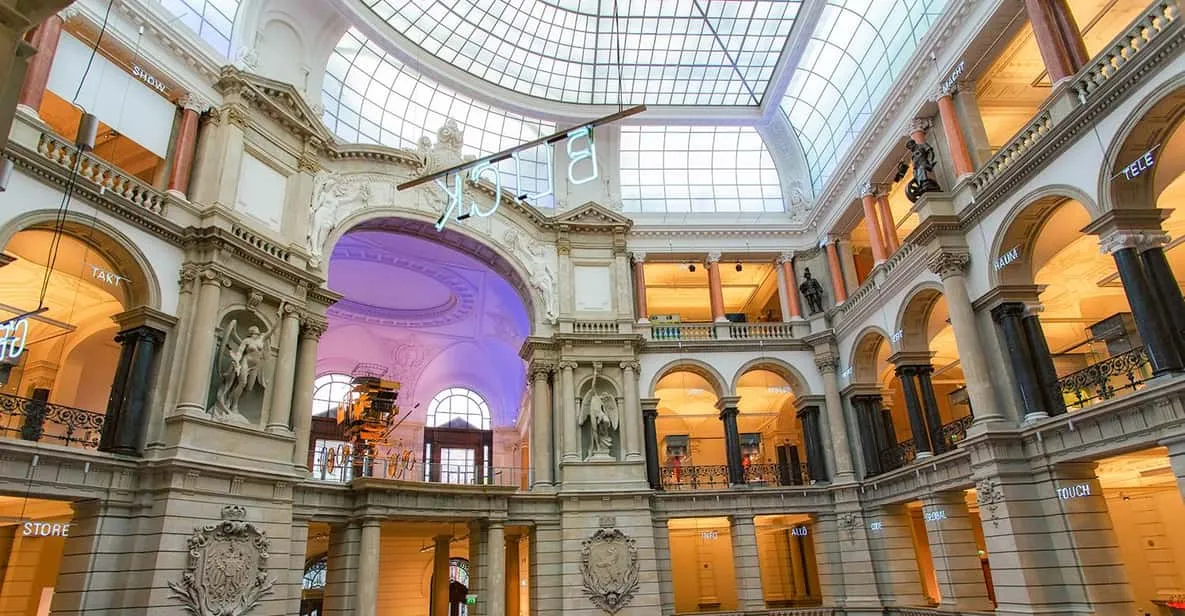
A neo-baroque palace built in 1897 for the Imperial Post Office, the first postal museum in the world. Its glass roofed three storey atrium came through the war and the GDR decades and was restored in the 1990s; it is one of the best interiors in Mitte.
The atrium robots ROBerta and ROBert, a Blue Mauritius stamp in the treasure chamber, an original Enigma machine, Philipp Reis's 1861 telephone, a working Rohrpost tube, a Morse telegraph station and a small television studio.
Check Live Availability & Prices
This is a quiet museum by Mitte standards, so entry is rarely a problem, but a booked ticket saves the counter on a wet afternoon. Live dates and prices are below.
Which Museum of Communication Ticket to Pick
One product covers it. The entrance ticket at $9 gets you the whole museum: the atrium and its robots, the treasure chamber, the historical collection across three levels and the hands-on stations, with no separate charge for the special rooms. It holds 4.5 from 493 reviews.
The museum app runs three guided audio-visual tours in German and English at no extra cost, so there is nothing further to buy once you are through the door.
It suits families with children roughly 5 to 12 better than most museums in the district, because the robots, the pneumatic post, the Morse key and the television studio are all things a child can operate rather than look at. The building is fully step-free with ramp and lift access and accessible toilets. The economics are unusually kind: adults pay 8 euros at the door, concessions 4 euros, and under 18s nothing, so two parents with three children pay 16 euros in total, which is not a sentence you get to write often about central Berlin.
What it is not is a headline attraction. It is mid-sized, 90 minutes to two hours covers it, and no guided tour, workshop or catering is bundled into the price beyond the cafe and shop on site. It works best as a rainy hour folded into a walk between Checkpoint Charlie, Gendarmenmarkt and Potsdamer Platz rather than a trip made specially.
For where it fits against the bigger houses, see our roundup of museums in Berlin.
Museum für Kommunikation Berlin Tickets
The entrance ticket covering the atrium, the treasure chamber and all three levels, with live pricing.
from $9 Museum of Communication Entrance Ticket
The oldest postal museum in the world, with three robots loose in a domed atrium and the Blue Mauritius stamps locked in the treasure chamber. One of the…
- World's oldest postal museum
- Robots in the atrium
- Blue Mauritius stamps
What You'll See
The atrium does the first minute of work for you. Two interactive robots, ROBerta and ROBert, move around the glass roofed hall greeting visitors and occasionally holding conversations with each other, and children head straight for them. Off the atrium sits the treasure chamber, with a Blue Mauritius stamp, one of the most valuable stamps in the world, alongside other rarities.
Nearby are two objects that carry more weight than their size suggests: an original Enigma cipher machine, and Philipp Reis's first telephone from 1861, one of the founding objects of telephony.
The rest is meant to be operated. A working Rohrpost installation lets you send a message through a pneumatic tube, a nod to the city-wide Berlin tube post network that ran until 1976, and reviewers repeatedly name it the best thing in the building while plenty of visitors walk past it without noticing. There is a Morse telegraph station where you can send a telegram, early teleprinters beside it, and a small television studio where visitors read the news on camera.
Around all of that runs the long story the museum is actually telling, from Stone Age hand axes and smoke signals through historic mail coaches to smartphones and virtual messaging.

How a Visit Flows
-
14:00
In from Leipziger Strasse
Anton-Wilhelm-Amo-Strasse on the U2 is three minutes away, Stadtmitte about five. Coat lockers are on the lower level, staffed at weekends from October to Easter. Mid afternoon is the calm slot, since this museum never gets the Museumsinsel crush.
-
14:10
The robots first
Go to the atrium before working through anything chronologically. ROBerta and ROBert are what children remember, and getting that out of the way buys you goodwill for the rooms upstairs.
-
14:35
The treasure chamber
The Blue Mauritius stamp and the other rarities are in one small, dim room. Five minutes, but it is the room people are surprised by.
-
15:00
Send something through the tube
The Rohrpost is the station most visitors miss and the one they rate highest afterwards. The Morse key and the teleprinters sit alongside it.
-
15:30
Enigma, Reis and the upper levels
The Enigma machine and Philipp Reis's 1861 telephone anchor the historical rooms, and the mail coaches are on the way through. The television studio is the last thing children will want to do, so save it.
-
16:00
Out and onward on foot
Ninety minutes to two hours is a full visit. Checkpoint Charlie and Gendarmenmarkt are both within ten minutes, and Potsdamer Platz is a straight walk west along Leipziger Strasse.
Know Before You Go
Not suitable for
- Monday arrivals, when the museum is closed, along with Easter Monday, Whit Monday and the days around Christmas and New Year
- Visitors looking for a half-day museum, since the whole thing takes about two hours
- Anyone wanting a headline collection, because the pleasure here is the building and the hands-on stations
What to bring
- A charged phone for the museum app, which runs three guided tours in German and English
- ID for a concession claim, and nothing at all for under 18s who enter free
- Coins or a card for the cafe and shop on the ground level
- A message worth sending, because the pneumatic tube takes a real note
Not allowed
- Entry on a Monday or on the listed holiday closures, which catch out a lot of walk-ups
- Coats and larger bags in the galleries, which go to the lockers on the lower level
- Arrival after 17:00 on a weekday, since the museum closes an hour earlier than at weekends
Insider Tips
Six things regular visitors do differently from first timers.
- Head for the atrium robots first instead of working the ground floor in order, because that is what children come out talking about
- Actually send a message through the pneumatic post; reviewers call it the highlight and a lot of visitors walk straight past it
- Use it as a decompression stop mid afternoon, since it is genuinely quiet compared with the Museumsinsel houses fifteen minutes away
- Go for the interior even if the subject leaves you cold, as the 1897 atrium is worth the 8 euros on its own
- Walk it into Checkpoint Charlie and Gendarmenmarkt rather than making a special trip, because all three sit within ten minutes of each other
- Remember that adults pay adult tickets only, so two parents and three children come to 16 euros in total
Where You're Headed
Museum für Kommunikation Berlin FAQ
How much does the Museum für Kommunikation Berlin cost?
Adults pay 8 euros at the door and concessions 4 euros, which covers students, trainees, Berlin Pass holders, visitors with a disability and groups of 15 or more. Everyone under 18 is free. The bookable online entrance ticket is $9.
What are the opening hours of the Museum of Communication in Berlin?
Tuesday to Friday 09:00 to 17:00, and Saturday, Sunday and public holidays 10:00 to 18:00. It is closed every Monday, and also on Easter Monday, Whit Monday, 23 and 24 December, 31 December and 1 January.
Is the Museum für Kommunikation Berlin free for children?
Yes. Everyone under 18 enters free, so a family pays only for the accompanying adults. Kindergarten and school groups are free as well, along with refugees, ICOM members and MuseumsuferCard holders. There is no monthly free day for adults: Berlin's Museumssonntag scheme held its last edition on 1 December 2024.
How long do you need at the Museum of Communication Berlin?
Ninety minutes to two hours. It is a mid-sized museum spread over an atrium and three levels, and families who work through the robots, the tube post, the Morse station and the television studio land at the upper end of that.
Which U-Bahn stop is the Museum für Kommunikation Berlin?
Anton-Wilhelm-Amo-Strasse on the U2, formerly called Mohrenstrasse, about three minutes on foot. Stadtmitte on the U2 and U6 is roughly five minutes, buses M48, 200 and 265 stop nearby, and Potsdamer Platz is a ten minute walk along Leipziger Strasse.
Is the Museum für Kommunikation Berlin in English?
Yes. Labelling runs in German and English, and the museum app carries three guided audio-visual tours in both languages.
Where is the Blue Mauritius stamp displayed in Berlin?
In the treasure chamber of the Museum für Kommunikation on Leipziger Strasse, shown alongside other philatelic rarities. It is one of the most valuable stamps in the world and the room is small and easy to walk past, so look for it off the atrium.
Is the Museum of Communication Berlin good for kids?
It is strong for roughly ages 5 to 12, because so much of it can be touched or operated: the two atrium robots, the pneumatic tube post, the Morse telegraph station and the television studio where children read the news on camera. The building is fully step-free, so pushchairs are easy.
What Visitors Say
We ducked in out of the rain between Checkpoint Charlie and Gendarmenmarkt and stayed two hours. The children spent half of it following the robots around the atrium.
Sent a note through the pneumatic tube, which nobody had told us about. That and the Enigma machine were worth the whole visit.
Two adults, three children, sixteen euros. After Museum Island prices that felt like a mistake. It is not huge, but the atrium alone is worth walking in for.