How much are Natural History Museum Berlin tickets and is Tristan the T. rex still on display?
The Museum für Naturkunde stands on Invalidenstrasse in Mitte, five minutes from its own U-Bahn stop, in a Prussian block that has been holding natural history since 1889. Behind the public galleries sit roughly 30 million objects; in front of them are the tallest mounted dinosaur skeleton in the world, the Berlin Archaeopteryx and a glass walled room of 276,000 specimen jars. This guide covers the door prices, the timed entry ticket, what is actually on show in 2026, and how to run the visit with children in tow.
About This Experience
Invalidenstrasse 43, Mitte, 10115 Berlin, on the north side of the street between Hauptbahnhof and Nordbahnhof.
U6 to Naturkundemuseum is the closest stop, roughly 300 m and about 4 minutes on foot. Trams M5, M8, M10 and M12 and bus 245 also stop at Naturkundemuseum. S-Bahn Nordbahnhof (S1, S2) is about 900 m, roughly 12 minutes, and Berlin Hauptbahnhof about 1,300 m, roughly 17 minutes. There is no visitor parking and street parking nearby is limited, so come by public transport or bike.
Tuesday to Friday 09:30 to 18:00. Saturday, Sunday and public holidays 10:00 to 18:00. Last admission is 30 minutes before closing. Closed every Monday, and closed on 24, 25 and 31 December.
At the door, adults aged 16 and over pay 11 euros, children aged 6 to 15 and concessions pay 5 euros, and under 6s are free. A family ticket for 2 adults and up to 3 children under 14 is 18 euros; the small family ticket for 1 adult and up to 2 children is 12 euros. Groups of 10 or more pay 8 euros per adult. Annual passes run 35 euros adult, 65 euros family. There is no monthly free entry day here.
A neoclassical Prussian building opened in 1889 as part of the Humboldt University complex. The east wing stood as a war ruin for decades and was rebuilt in 2010 with a cast concrete replica facade, which you can read plainly from the courtyard side.
The 13.27 m Giraffatitan brancai, Tristan Otto the Tyrannosaurus rex, the Berlin Archaeopteryx, the wet collection of 276,000 jars, Knut the polar bear and Bobby the gorilla.
Check Live Availability & Prices
Entry runs in one hour slots, released up to 14 days ahead. Weekend and school holiday mornings are the first to fill. Live dates and prices are below.
Which Natural History Museum Ticket to Pick
There is one bookable product and it does one thing well. The online entrance ticket at $13 reserves a one hour arrival window and lets you walk in rather than queue at the desk. It covers the permanent galleries, the dinosaur hall, the wet collection and the mineral rooms, and it holds a 4.6 rating from 3,559 reviews, which is a large enough sample to trust.
Slots open 14 days ahead.
It suits anyone arriving at a weekend, in the Berlin school holidays, or with children who will not tolerate a queue. Note the honest maths: walk-up admission is 11 euros for an adult, so the booked slot costs a little more than the door. If you are two adults with three children under 14, the 18 euro family ticket at the counter is far cheaper than five separate online tickets, and on a quiet Tuesday afternoon the queue you are avoiding barely exists.
Buy online for certainty of timing, not to save money.
What the ticket does not include is any kind of guide or tour. There is no live commentary, and no paid audio unit worth chasing; the museum's own digital guide runs free on your phone in 11 languages, with a separate children's version and a German Sign Language version, so bring headphones and load it before you arrive because the wifi is patchy inside the stone halls. Two hours is the museum's own suggested visit length, which leaves room to pair this with something else from the best museums in Berlin for families rather than blocking out a whole day.
Natural History Museum Berlin Tickets
The timed entrance ticket, with live pricing and the next available slots.
from $13 Natural History Museum Entrance Ticket
The Museum für Naturkunde holds the tallest mounted dinosaur skeleton in the world, a Brachiosaurus from Tanzania, and the Berlin Archaeopteryx, the best specimen of its kind anywhere…
- World's tallest mounted dinosaur
- The Berlin Archaeopteryx
- Best museum in Berlin for kids
What You'll See
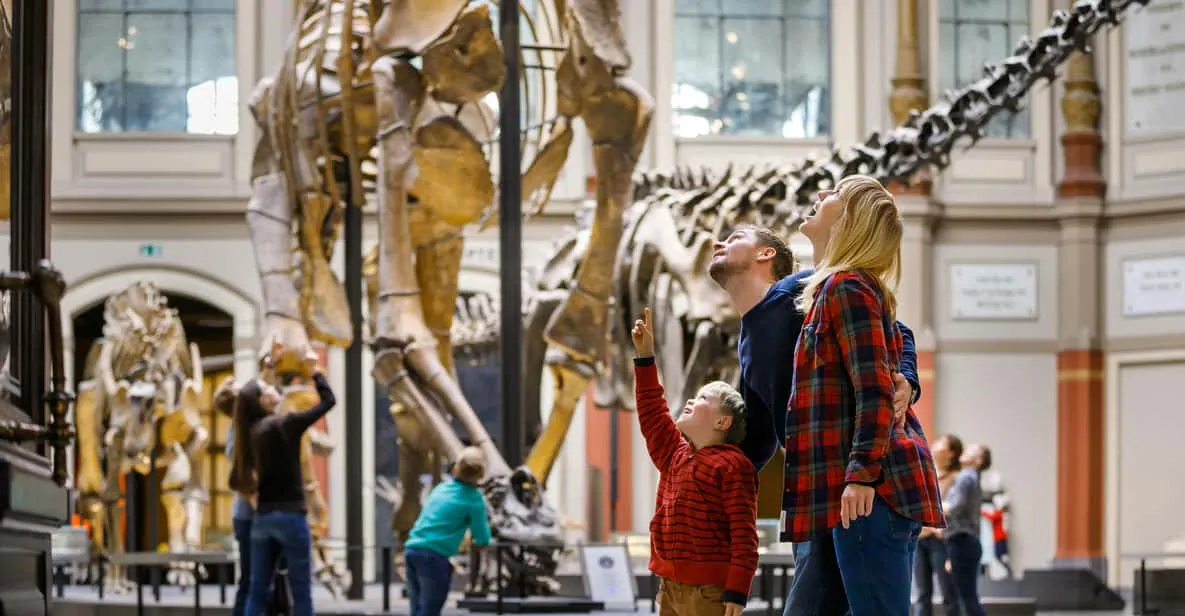
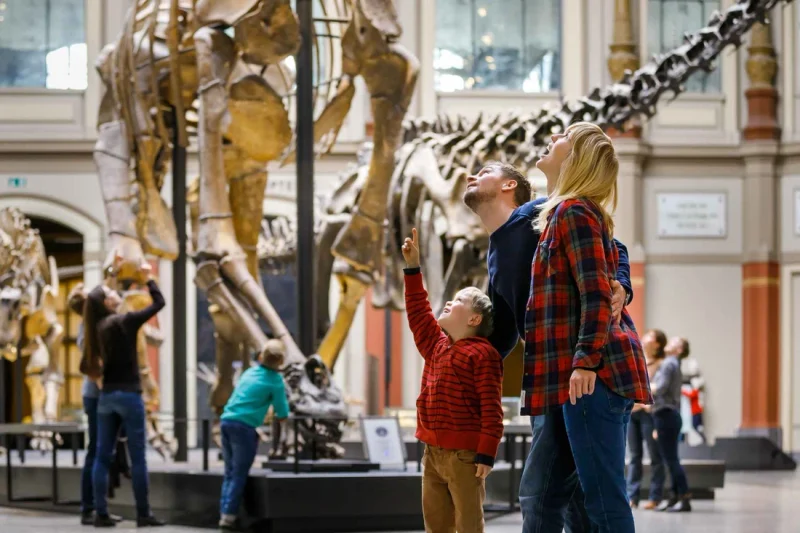
The Dinosaur Hall is why most people come and it earns it. The mounted Giraffatitan brancai, long labelled Brachiosaurus brancai, stands 13.27 m tall and 26.8 m long, the tallest mounted dinosaur skeleton anywhere, excavated on the German Tendaguru expeditions in what is now Tanzania between 1909 and 1913. Tristan Otto, one of the best preserved Tyrannosaurus rex skeletons in the world, was found in the Hell Creek Formation in Montana in 2010 and runs about 12 m long and 4 m high, with bone that reads almost black.
He is on loan and is the centrepiece of the special exhibition DINOSAURS! Age of the Giant Lizards, which has been extended to 30 November 2026, so he is not part of the standing display and will not be there forever. A Triassic Plateosaurus and a 3D printed Triceratops skull sit alongside him, laying out three geological periods in one room.
The rest of the building is quieter and better than its reputation. The Berlin specimen of Archaeopteryx lithographica, lifted from Solnhofen limestone in 1874 or 1875, is the most complete example known and the first found with a clear skull; it gets called the Mona Lisa of fossils and the small crowd around its case is the giveaway. In the rebuilt east wing the wet collection runs behind glass: roughly 276,000 jars of alcohol-preserved specimens on steel shelving, one of the most photographed rooms in the city.
Then there are the two animals Berlin actually mourned, Knut the polar bear from the 2007 media story and Bobby the gorilla, who died at the zoo in 1935 and is shown with an account of the public grief that followed.
How a Visit Flows
-
13:30
Arrive and drop everything
Mornings are the museum's own busiest window, so a booked early afternoon slot is calmer. The cloakroom is free and compulsory for anything larger than A4, and the lockers take a 1 euro coin that comes back. Suitcases cannot be stored at all, so do not come straight from Hauptbahnhof with luggage.
-
13:45
Straight into the Dinosaur Hall
Walk past the ticket desk into the big hall before doubling back. Most arrivals drift into the smaller rooms on the left first, which leaves the Giraffatitan and Tristan with breathing space for a while.
-
14:30
Archaeopteryx and the fossil rooms
The Berlin Archaeopteryx sits in its own case nearby. Children who are done with dinosaurs by now will keep going for the minerals and the meteorite material, which is the next room adults tend to skip.
-
15:15
Coffee before the second half
Cafe MarcAnn's is on site. The galleries are not air conditioned, so on a July or August afternoon this stop matters more than it sounds and the museum itself tells visitors to bring water.
-
15:45
The wet collection
The glass walled jar room in the east wing is calmest in the last hour, once the dinosaur crowd has left the building. Give it ten minutes rather than one photograph.
-
16:30
Out and onward
Two hours covers the permanent galleries comfortably, three if children linger. Nordbahnhof and the Berlin Wall Memorial are about 12 minutes on foot, and Hamburger Bahnhof is a similar walk the other way.
Know Before You Go
Not suitable for
- Monday arrivals, and anyone in Berlin only on 24, 25 or 31 December
- Travellers with suitcases, since large luggage cannot be stored anywhere in the building
- Anyone counting on Tristan Otto after 30 November 2026, when the special exhibition he anchors is currently set to end
What to bring
- Headphones and a charged phone for the free digital guide, loaded before you arrive
- A 1 euro coin for the lockers, refunded when you take your bag back
- Water, especially in summer, because the halls are not air conditioned
- ID for a concession or family claim at the counter
Not allowed
- Bags larger than A4 in the galleries, which go to the compulsory cloakroom first
- Suitcases and large luggage anywhere in the building, including the cloakroom
- Entry more than 30 minutes before closing, since last admission is 17:30
Insider Tips
Six things regular visitors do differently from first timers.
- Walk straight into the Dinosaur Hall and double back afterwards, because nearly everyone turns left into the smaller rooms first
- Save the wet collection for the last hour before closing, when the dinosaur crowd has already left through the front
- Aim for a weekday late afternoon slot; early afternoon and weekend mornings are the crush, and the museum itself points walk-in groups to midday onward
- Two hours really does cover the permanent galleries, so pair it with Hamburger Bahnhof or the Berlin Wall Memorial instead of planning a full day
- Load the free digital guide on your own phone before you go in rather than hunting for an audio unit, since the wifi is weak inside the stone halls
- If the Deutsches Technikmuseum is also on your list, buy that ticket first, because a valid one brings a companion in here free
Where You're Headed
Natural History Museum Berlin FAQ
How much does the Natural History Museum Berlin cost?
At the door, 11 euros for adults aged 16 and over, 5 euros for children aged 6 to 15 and for concessions, and free for under 6s. The family ticket for 2 adults and up to 3 children under 14 is 18 euros, and the small family ticket for 1 adult and up to 2 children is 12 euros. The timed online entrance ticket is $13.
What are the opening hours of the Museum für Naturkunde Berlin?
Tuesday to Friday 09:30 to 18:00, and Saturday, Sunday and public holidays 10:00 to 18:00. Last admission is 30 minutes before closing. The museum is closed every Monday and on 24, 25 and 31 December.
Is Tristan the T. rex still on display in Berlin in 2026?
Yes. Tristan Otto is shown as the centrepiece of the special exhibition DINOSAURS! Age of the Giant Lizards, which has been extended to 30 November 2026. He is on loan rather than part of the permanent collection, so check the exhibition is still running before you build a trip around him.
How long do you need at the Natural History Museum Berlin?
The museum suggests two hours, and that is realistic for the permanent galleries. Families who let children work through the dinosaur hall and the mineral rooms at their own speed usually stretch it to three.
Is the Natural History Museum Berlin free on Sundays?
No. Berlin's Museumssonntag scheme, which made many city museums free on the first Sunday of the month, held its final edition on 1 December 2024 and has not returned. Any page still promising free first Sundays here is out of date. Free entry now applies only to under 6s, pre-school children, teachers with school groups, ICOM members, press card holders and carers of severely disabled visitors.
Are the exhibits labelled in English?
Yes. Labels are bilingual German and English throughout, and the museum's free digital guide runs on your own phone in 11 languages, with a separate children's version in German and English and a German Sign Language version.
Which U-Bahn stop is the Natural History Museum Berlin?
Naturkundemuseum on the U6, about 300 m and four minutes from the entrance. Trams M5, M8, M10 and M12 and bus 245 use the same stop, and Nordbahnhof on the S1 and S2 is roughly 12 minutes on foot.
Is the Natural History Museum Berlin good for toddlers and young children?
It works best for roughly ages 4 to 12, and the dinosaur hall does most of the work. Pushchairs are allowed throughout the building, so under 4s are easy to bring along even if the labels are lost on them.
What Visitors Say
We booked a 14:00 slot on a Wednesday and walked straight past the desk queue. Our six year old spent forty minutes just circling the big skeleton.
The jar room is the part I keep thinking about. We went at half five when everyone else had gone and had the whole gallery to ourselves.
Warm in August and no air conditioning, so take water. Two hours was enough for us and the English labels meant nobody was left guessing.